

Heritage Day is one of the most colourful dates on the South African school calendar, making it a great opportunity for learners to explore where they come from, learn about one another and get creative at the same time.
In 2026, Heritage Day falls on Thursday, 24 September, creating a long weekend. Depending on the school calendar, some classrooms may hold their Heritage Day activities on the Wednesday before or the Friday around the holiday instead.
Whether you are a parent helping with a last-minute school project or a teacher planning something for the whole class, these Heritage Day poster ideas and easy crafts can help children celebrate South Africa’s cultural diversity in a fun and meaningful way.
What Is Heritage Day and Why Do We Celebrate It?
Before the scissors, glue and colouring pencils come out, it helps children understand why Heritage Day matters.
Heritage Day has its roots in a KwaZulu-Natal observance known as Shaka Day, which was held on 24 September in honour of Zulu King Shaka. When South Africa’s new Parliament considered the Public Holidays Bill after apartheid, the omission of Shaka Day was challenged by the Inkatha Freedom Party. A compromise was eventually reached: 24 September would become a national holiday on which all South Africans could celebrate the country’s diverse cultural heritage. (South African History Online)
In a 1996 Heritage Day address, Nelson Mandela explained the thinking behind the holiday, saying that South Africa’s “rich and varied cultural heritage has a profound power to help build our new nation.” (South African History Online)
From Heritage Day to “Braai Day”
Heritage Day later became informally associated with “Braai Day” through the Braai4Heritage initiative led by Jan Scannell, better known as Jan Braai. Archbishop Desmond Tutu became the campaign’s National Spokesperson in 2007.
The idea was simple: although South Africans come from many different cultures and backgrounds, gathering around a braai is something many people can enjoy together. (South African History Online)
That wider message is worth keeping in mind when planning Heritage Day activities for children. A good project should do more than look colourful; it can also give learners a chance to explore identity, traditions and the many cultures that form part of South Africa.
Heritage Day Poster Ideas for School Projects
A poster is one of the easiest Heritage Day projects to adapt for different ages.
Younger children can keep things visual with drawings, flags and pictures, while older learners can add research, short descriptions and personal reflections.
Here are five Heritage Day poster ideas to get started.
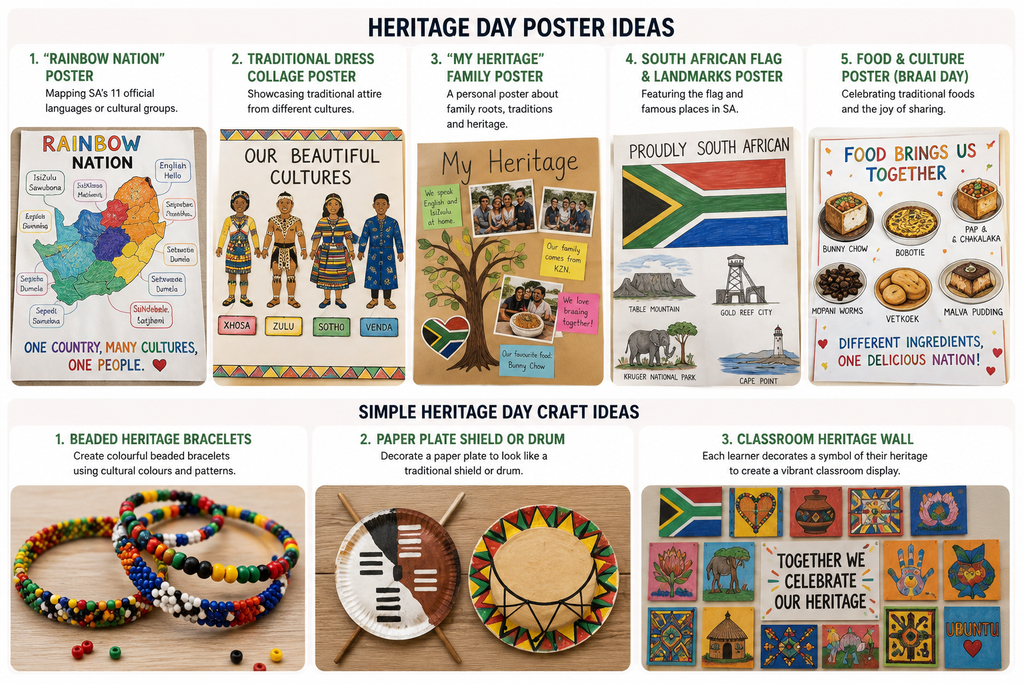
1. Create a “Rainbow Nation” Poster
Celebrate the variety of languages, traditions and communities found across South Africa.
Learners could divide a poster into sections and include greetings or words from South Africa’s official languages, illustrations of different cultural traditions, or symbols representing different parts of the country.
For younger children, keep it simple by using bright colours, drawings and cut-out shapes.
You will need:
- Poster or project board
- Colouring pencils
- Permanent markers
- Craft paper
- Glue
2. Make a Traditional Dress Collage
Clothing can be a wonderfully visual way to introduce children to different cultural traditions.
Learners can draw traditional attire, use printed pictures supplied by a teacher or family, or create outfits from patterned paper and fabric scraps.
Encourage children to label what they have included and, where possible, explain why particular colours, patterns or clothing items are meaningful.
You will need:
- Craft paper pads
- Craft glue
- Scissors
- Colouring pencils
- Poster board
- Fabric scraps or decorative paper, if available
3. Create a “My Heritage” Family Poster
Heritage does not have to be presented only as a broad national topic. It can also be personal.
Ask children to create a poster about their own family heritage. They might include:
- Where their family comes from
- Languages spoken at home
- Family traditions
- Favourite heritage foods
- Songs, stories or celebrations
- A special family recipe or saying
- Something an older family member has taught them
This can be a particularly meaningful project because it encourages learners to speak to parents, grandparents or caregivers and discover more about their own family story.
You will need:
- Poster board
- Family photos or printed images, where appropriate
- Markers
- Colouring pencils
- Craft glue
4. Design a South African Flag and Landmarks Poster
For a project with a strong national theme, learners can create a poster combining the South African flag with well-known places, landscapes and symbols.
They could draw or collage landmarks from around the country and add a short sentence about why each one is important or special.
The final result can become a colourful celebration of the different places that make up South Africa.
You will need:
- Poster or project board
- Wax crayons
- Colouring pencils
- Markers
- Ruler
- Craft paper
5. Make a South African Food and Culture Poster
Food is often one of the easiest ways for children to connect with heritage.
Learners could create a poster featuring foods their families enjoy or dishes associated with different South African communities. They can draw the food, add photographs or create paper cut-outs and then add a short explanation.
The informal “Braai Day” association with Heritage Day can also be included here, with older learners explaining how the idea of sharing a braai was promoted as a way for South Africans from different backgrounds to gather together. (South African History Online)
You will need:
- Poster board
- Craft paper
- Glue
- Markers
- Colouring pencils or crayons
Simple Heritage Day Craft Ideas for Kids
Posters are not the only way to celebrate. If you are looking for more hands-on Heritage Day craft ideas, there are plenty of classroom-friendly options that can work for different ages.
Make Beaded Heritage Bracelets
Beading can be used as a simple colour and pattern activity.
Children can choose colours that are meaningful to them, create repeating patterns or make friendship bracelets to exchange with classmates.
For younger learners, larger beads and a simple colour sequence can make the activity easier to manage.
Teachers can also use the activity as a starting point for discussing how beadwork and decorative patterns can carry cultural meaning, while reminding learners that traditions differ between communities and should be represented respectfully.
Create a Paper Plate Shield or Drum
Paper plates and card can be transformed into decorative shields or drums using paint, crayons, paper shapes and patterns.
Encourage children to design their own patterns rather than presenting one design as representative of an entire culture.
For an extra three-dimensional element, modelling clay or play dough can be used to create small decorative pieces or symbols to add to the project.
Build a Classroom Heritage Wall
One of the easiest Heritage Day activities for kids is also one of the best for getting the whole class involved.
Give every learner a piece of card or paper and ask them to decorate it with something that represents heritage to them.
It could be:
- A family tradition
- A language or special word
- A favourite food
- A pattern or colour
- A place in South Africa
- A family story
- Something they are proud of
Combine all the individual pieces on a classroom wall or noticeboard to create one large Heritage Day display.
The result highlights an important part of the celebration: each learner may bring something different, but all the pieces belong together.
What You’ll Need for Your Heritage Day Project
You do not need a complicated list of materials to put together a great project.
A few versatile craft basics can cover most of the ideas above:
- Poster and project board
- Craft paper pads
- Craft glue
- Child-safe scissors
- Colouring pencils
- Wax crayons
- Permanent markers for headings and lettering
- Rulers and pencils
- Modelling clay or play dough for 3D details
- Decorative materials such as ribbon, fabric scraps, stickers or beads
Before buying anything new, check what is already in the classroom craft cupboard or at home. Offcuts of paper, leftover board and recycled materials can often become part of the project too.
Make Heritage Day Creative, Personal and Meaningful
The best Heritage Day project does not have to be the biggest or most elaborate one in the classroom.
What matters is that children have an opportunity to think about heritage, ask questions, share something about themselves and learn something about the people around them.
Whether your child is creating a family heritage poster the night before it is due or your class is building a colourful display together, a few basic supplies and a little imagination can go a long way.
With Heritage Day falling on 24 September 2026, now is a good time to gather what you need and start planning your activity.
Get Your Heritage Day Craft Supplies Ready
Find poster board, colouring supplies, craft paper, glue and plenty more at PNA and give your Heritage Day project a colourful start.
And if you are refreshing the classroom for spring at the same time, you might also enjoy PNA’s Refresh Your Classroom: A Teacher’s Guide to Spring Organisation and Creative Crafts.
Happy crafting, and happy Heritage Day!